

How to Swim Backstroke Faster: Fix the Head First
Backstroke speed comes from the head. Lie back so your ears are submerged and you are looking straight up at the ceiling, not down at your feet. Almost every slow backstroke is a swimmer with their chin tucked, watching their toes, hips sagging, dragging their own body through the water. Fix the head, and rotation, hips and stroke length improve by themselves. Then — and only then — work on the arms.
Backstroke is the most under-taught stroke in adult swimming. It is also the easiest to breathe in, which makes it the kindest stroke for a nervous beginner who has been fighting freestyle.
Head, Then Hips
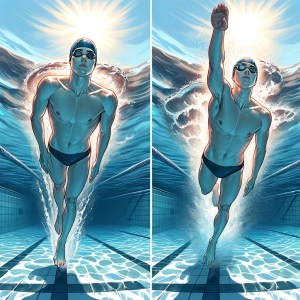
Put the back of your head in the water. Ears under. Eyes on the ceiling, or very slightly back towards where you came from. The water should break somewhere around your goggle straps.
Now press your chest very gently down, the way you would in freestyle. The hips come up. You are flat.
That is it. Nothing else in backstroke matters until the head is right, because a lifted chin drops the hips and turns the whole stroke into towing.
One complication: many swimmers instinctively lift the head because they cannot see the wall. That is a real problem with a real solution, and it is not “look at your feet”. See below.
The Arms
- 入水。 Little finger first, arm straight, entering at roughly eleven o’clock and one o’clock — in line with the shoulder, not out wide and not across the head.
- 抓水。 Once under, bend the elbow. The forearm becomes the paddle. A straight-arm pull all the way through is a common and inefficient habit.
- 划手。 Press the water down towards your feet, past the hip.
- 出水。 Thumb first, out past the thigh.
- 回臂。 Straight arm, relaxed, brushing past your ear. The hand rotates so the little finger leads again on entry.
One arm enters as the other exits. They are opposite each other, always.
Rotation Is Not Optional
Backstroke is swum on the sides, like freestyle. Your shoulders should roll noticeably — the entering shoulder drops, the recovering shoulder lifts clear of the water.
The head stays perfectly still while the body rotates beneath it. This is the hardest thing in the stroke and the most valuable. If your head rolls with your shoulders, you will swim in a zigzag and your neck will ache.
The Kick
Small, fast, from the hip. Knees stay under the surface; toes just break it, producing a low boil rather than a splash. Ankles loose.
A bicycling kick with bent knees is the standard fault, exactly as in freestyle, and it brakes rather than propels. Stiff ankles — the curse of runners and cyclists — make backstroke kick feel useless for the first few weeks.
Common Faults and Fixes
| 问题 | Consequence | 练习方向 |
|---|---|---|
| Chin tucked, watching feet | Hips sink; you tow yourself | Ears under, eyes on the ceiling |
| Head rolls with shoulders | Zigzag; neck ache | Fix the eyes on one ceiling tile |
| Arm entry across the head | Shoulder strain; body snakes | Enter at eleven and one |
| Straight-arm pull underwater | Weak, slow | Bend the elbow; press with the forearm |
| No rotation, swimming flat | Short stroke, sore shoulders | Let the shoulder roll clear each stroke |
| Bent-knee bicycling kick | Drag, exhaustion | Kick from the hip; knees stay under |
| Water over the face | Panic, coughing | Chin slightly up; exhale through the nose |
Swimming Straight, and Finding the Wall

Pick a fixed point on the ceiling and keep your eyes on it. Use your peripheral vision to watch the lane rope on each side. If one rope is getting closer, you are veering; correct with a slightly longer pull on that side.
For the wall, count your strokes. Most pools have backstroke flags five metres out; from the flags, most adults need a fixed number of strokes to reach the wall. Count it once, remember it, and stop guessing.
Never finish a backstroke length by looking back over your shoulder mid-stroke. And never swim backstroke in a crowded lane where you cannot see who is ahead.
安全注意事项
Backstroke is the stroke in which people hit their heads on walls and swim into other people. Count strokes, watch the flags, and swim in a lane where backstroke is permitted.
Water over the face is the other risk. Keep the chin slightly raised and exhale gently through the nose — a nose clip is entirely acceptable if it helps you relax.
Never practise underwater backstroke starts or long submerged dolphin kicks as breath-holding exercises. Prolonged or repeated breath-holding, especially after hyperventilating, causes shallow-water blackout — a silent, warningless loss of consciousness that has drowned strong swimmers in supervised pools.
Learn with a lifeguard on duty and never practise alone. Floating aids are teaching tools, not safety devices, and a child who cannot swim needs an adult within arm’s reach regardless.
If your shoulder or neck hurts, stop and see a physiotherapist. Backstroke entry across the centre line is a classic cause of shoulder impingement, and it does not resolve by swimming more.
Why Beginners Should Learn It
Your face is out of the water. You can breathe whenever you like. For an adult who has spent months panicking about freestyle breathing, backstroke is often the stroke where swimming finally becomes calm — and the confidence transfers straight back to freestyle.
If you cannot yet float on your back, start there; it is the prerequisite and it is worth its own weeks of practice. Nervous adults progress fastest in 一对一私人课程; children usually enjoy 小组游泳课程. Practise between lessons wherever you can — see 公寓泳池游泳课程. Once you can swim lengths, the real speed levers are in 划水次数与节奏。寻找附近设施和课程可使用 附近游泳课程.
Public pool timings and programmes are published by ActiveSG.
常见问题
Why do my hips sink in backstroke?
Your chin is tucked. Put your ears under the water and look at the ceiling. The hips will rise on their own.
How do I stop swimming into the lane rope?
Keep your eyes fixed on one point on the ceiling and stop your head rolling with your shoulders. Use peripheral vision to check both ropes.
How do I know when the wall is coming?
Count strokes from the backstroke flags. Do it once, deliberately, and then trust the count.
Why does water keep going up my nose?
You are letting the head drop back too far, or not exhaling. Chin slightly up, gentle exhale through the nose. A nose clip is fine.
Should my arms be straight or bent?
Straight on the recovery above the water. Bent underwater, with the forearm pressing back. A straight-arm underwater pull is weak.
Is backstroke easier than freestyle?
Breathing is easier, so nervous swimmers often prefer it. Swimming straight and finding the wall are harder. Learn both; each helps the other.


Leave a Comment