
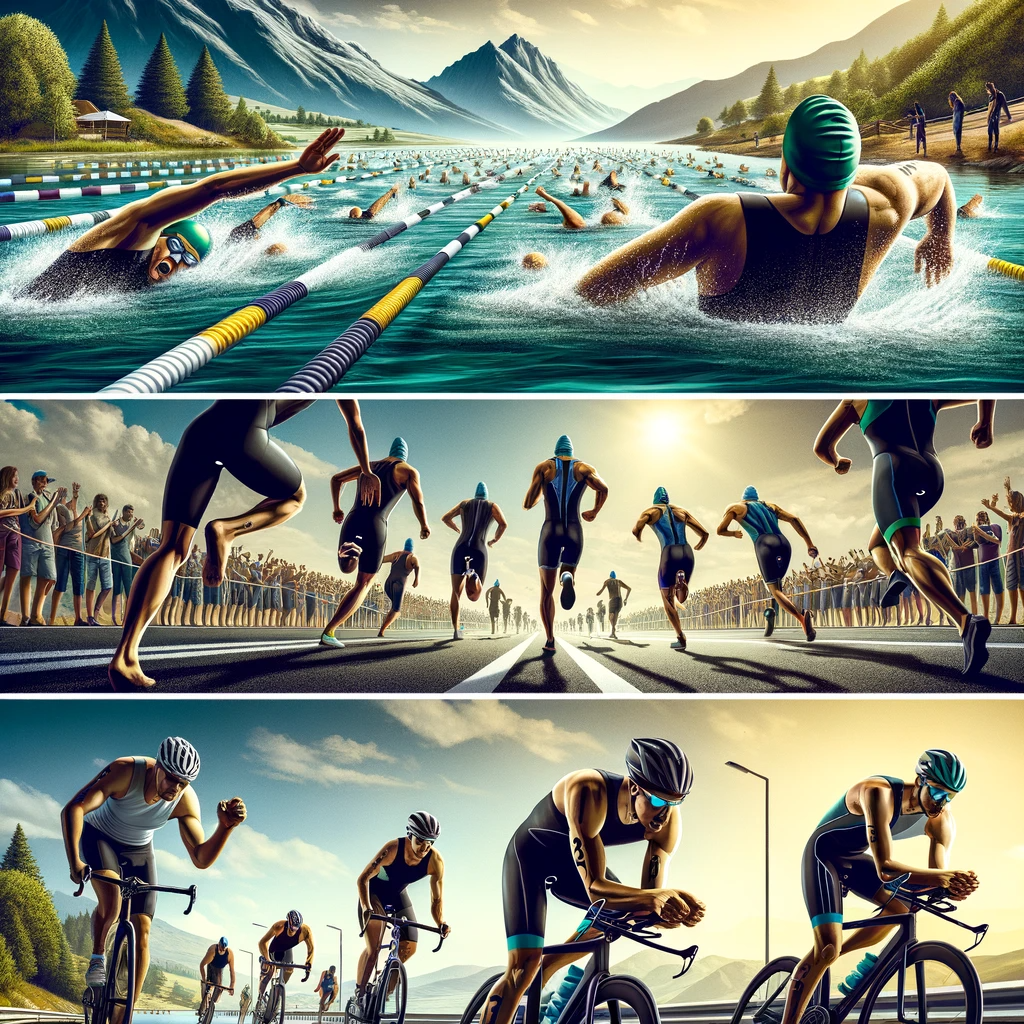
Most people who enter a triathlon can already run and cycle. The swim is the leg they signed up for and then quietly panicked about. Here is the reassuring part: the swim is the shortest leg, it is not timed against anybody who matters, and a competent adult can learn it from nothing in a few months. Here is the unreassuring part: fitness from running and cycling transfers almost not at all, and a strong runner with poor technique will be exhausted in fifty metres. Learn to swim properly. Then learn to swim in open water. They are different tasks.
The Distances
| Race | Swim | Bike | Run |
|---|---|---|---|
| Sprint (typical) | ~750m | ~20km | ~5km |
| Olympic / standard | 1.5km | 40km | 10km |
| Half distance (70.3) | 1.9km | 90km | 21.1km |
| Full Ironman distance | 3.86km | 180.25km | 42.2km |
Sprint distances vary between organisers. Check the specific race.
Notice that even at the full distance, the swim is a small fraction of the day. It is also the part in which the sport’s serious incidents occur, almost always in open water, almost always in the first few hundred metres, and almost always to people who panicked.
Why Runners Struggle in the Water

Three reasons, and none of them is fitness.
Dense, muscular legs sink. Runners and cyclists carry exactly the body composition that makes a horizontal body position hard. Your hips drop, your legs drag, and you tow yourself.
Stiff ankles. Years of running make ankles that cannot point. A stiff-ankled kick brakes rather than propels.
Breathing. On land you breathe whenever you want. In freestyle you breathe when the stroke lets you, and if you hold your breath in between — as almost every beginner does — you will be gasping within a length.
The first is unchangeable. The second improves slowly. The third is fixable this week: breathe out continuously while your face is in the water.
Learning the Swim, in Order
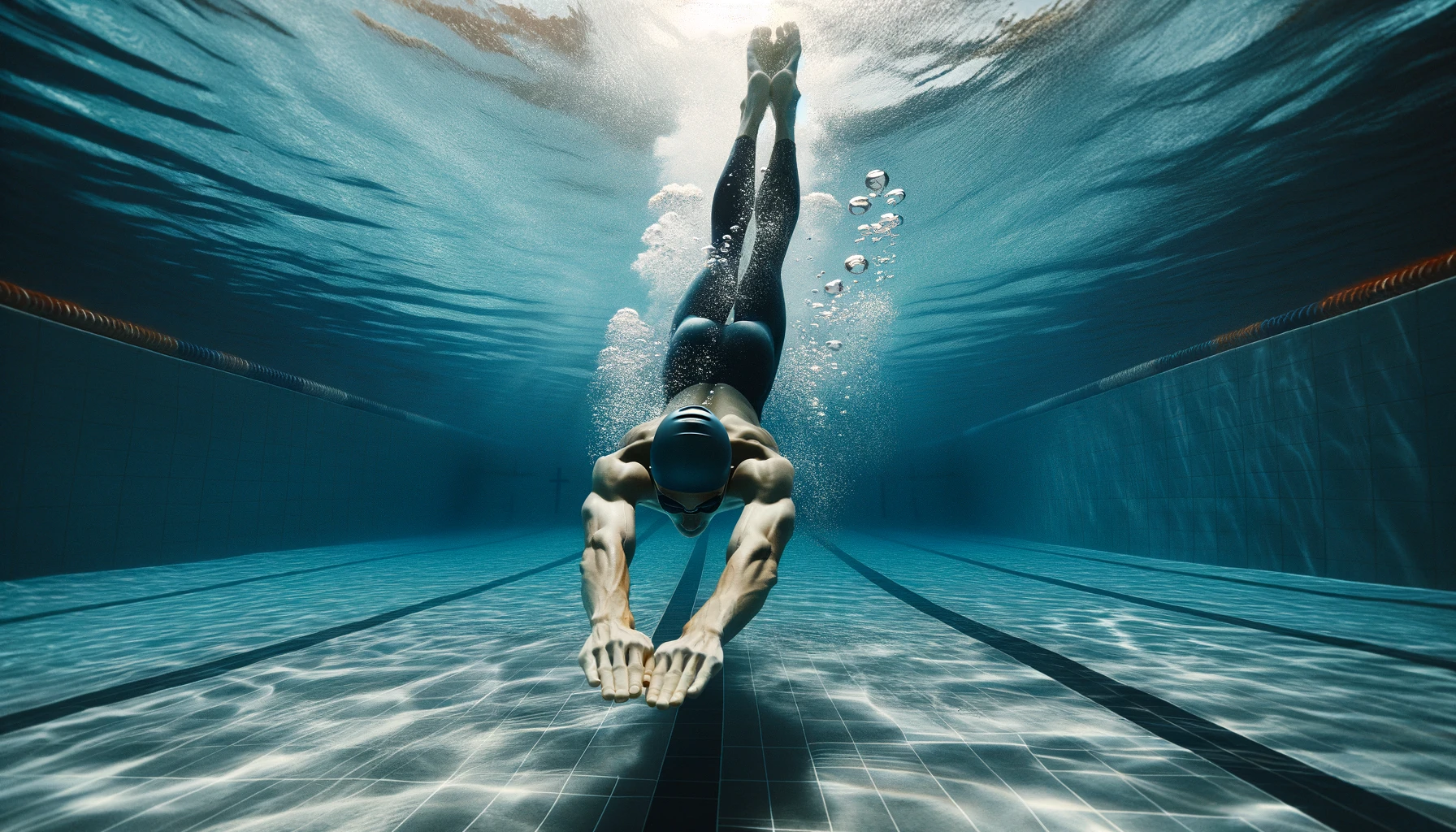
- Body position. Head down, eyes on the bottom of the pool, chest pressed gently. The hips rise. Nothing else matters until this is right.
- Breathing. Exhale continuously underwater. Rotate the head to breathe; never lift it. One goggle stays wet.
- 踢腿。 Small, fast, from the hip. Loose ankles. In a triathlon your kick contributes little propulsion — it is there to hold your legs up and save them for the bike.
- Arms. Entry in line with the shoulder, high elbow, press the water backwards.
- Bilateral breathing. Every three strokes. Not optional — in open water the chop comes from one side.
- Sighting. Lift the eyes forward every fifth or seventh stroke. Practise it in the pool, in a lane, until it costs you nothing.
A realistic timeline for an adult starting from nothing, swimming twice a week with a coach: twenty-five metres within weeks, four hundred metres continuous within a couple of months, a comfortable sprint-distance swim inside a season.
The Pool Is Not the Race

A swimmer who covers a comfortable kilometre in a lane can be in real trouble a hundred metres into a race swim. No wall. No line on the floor. No visibility. Chop on the breath. Bodies on every side, and somebody’s heel in your goggles.
The breathing goes first, then the calm.
So, before you race: swim in open water, repeatedly, with other people, in a patrolled area. Practise treading water and floating on your back — that is your reset when panic arrives, and it works. Start at the back and the outside of the swim wave. Enter the water gradually and let your breathing settle before you push off; entering cold water hot and out of breath triggers a gasp reflex that has drowned strong swimmers within seconds.
If you panic mid-swim, roll onto your back, float, breathe, raise an arm. Kayakers are there for this. Do not try to swim it off.
安全注意事项
- Never swim in open water alone. Ever.
- Never hold your breath or practise hypoxic sets. Prolonged or repeated breath-holding, especially after hyperventilating, causes shallow-water blackout — a silent, warningless loss of consciousness that has drowned strong swimmers in supervised pools. Triathletes are among the groups most tempted by it. Do not.
- Enter gradually. Wet your face and neck first.
- Wear a bright cap and, in training, a tow float. Boats do not see swimmers.
- Never after alcohol.
- Shoulder pain means stop. Triathletes add swimming volume to an already heavy training load, and swimmer’s shoulder arrives quickly. See a physiotherapist rather than swimming through it. Paddles and pull buoys accelerate the problem.
- Get a medical check before endurance racing if you have any heart or lung condition, or have not exercised in years.
常见误区
- Assuming running fitness transfers. It does not. Technique carries the swim.
- Swimming more instead of swimming better. Volume with sinking hips builds a fit swimmer with sinking hips.
- Kicking hard. You need those legs for two more hours. Kick to hold your body up, not to move.
- Breathing to one side only. Then the chop arrives on that side.
- Never swimming in open water before race day. The most dangerous omission in the sport.
- Starting at the front of the wave. You will be swum over.
- 长期依赖夹腿浮具。 It hides the exact fault you must fix.
Where to Start
With lessons, not with a training plan. A runner who has never been coached in the water is usually working twice as hard as necessary, and a coach on the deck finds in ten minutes what you would never find alone. Adults do best in 一对一私人课程 at first; 小组游泳课程 suit those who like company. Begin with 自由泳入门指南, build endurance with our 初学者游泳训练安排, and read why pool swimmers get caught out in open water before you enter a race. Swimmers ready for coached adult training will find a masters squad the fastest place to improve.
Race calendars and national programmes are published by Sport Singapore; pool timings by ActiveSG.
常见问题
Can I do a triathlon if I cannot swim?
Not yet, and yes eventually. Most adults reach a comfortable sprint-distance swim within a season of consistent lessons. Learn first; enter afterwards.
How far is the swim?
Around 750 metres at sprint distance, 1.5km at Olympic, 1.9km at half distance, and 3.86km at full Ironman distance. Sprint distances vary by organiser.
Why am I exhausted after fifty metres?
Breath-holding and sinking hips, almost always. Neither is a fitness problem. Fix the exhale first.
Do I need to kick hard in a triathlon swim?
No. Kick lightly to hold your legs up and save them for the bike and run.
Can I use a wetsuit?
Where race rules permit, and it helps buoyancy considerably. It is not a substitute for being able to swim, and it changes your stroke — practise in it.
What if I panic during the race swim?
Roll onto your back, float, breathe, raise an arm. Kayakers are there for exactly this. Practise the roll-and-float in training until it is automatic.


Leave a Comment