
Caeleb Dressel is an American sprint swimmer, an Olympic and world champion in the short freestyle events and the 100m butterfly. If your child has watched him and wants to train like him, the two things they will most want to copy — sprinting everything, and staying underwater as long as possible off the wall — are the two things they should not. One produces fast twelve-year-olds and injured sixteen-year-olds. The other can kill them.
I say this as someone who thinks watching elite swimming is wonderful for children. It just needs a translator.
Caeleb Dressel
What your child is actually watching
Dressel swam collegiately for the University of Florida and became one of the dominant sprinters of his era internationally. He is also, by the standards of the sport, enormously built through the shoulders and back, and he has spent well over a decade loading those tissues under supervision.
What looks like a technique in a slow-motion clip is often anatomy plus fifteen years. That is not a reason to be discouraged. It is a reason to be careful about which parts are copied.
Copy this, not that
| What your child sees | Copy it? | Why |
|---|---|---|
| Explosive start off the block | Yes | Practice and timing. Safe, and free time. |
| Tight streamline | Yes | The highest-return skill in the sport |
| Stroke holding shape when tired | Yes | Trainable, and mostly ignored |
| Long underwater phase | No | Encourages breath-holding. See below. |
| Sprinting every length | No | Early specialisation; shoulder injury |
| Aggressive high arm recovery | No | Adult shoulders, conditioned for a decade |
| Heavy gym work | No | Not on a growing skeleton, unsupervised |
The underwater phase: the part that frightens coaches
This needs saying without hedging, because the highlight reels encourage precisely the wrong behaviour and children imitate what they see.
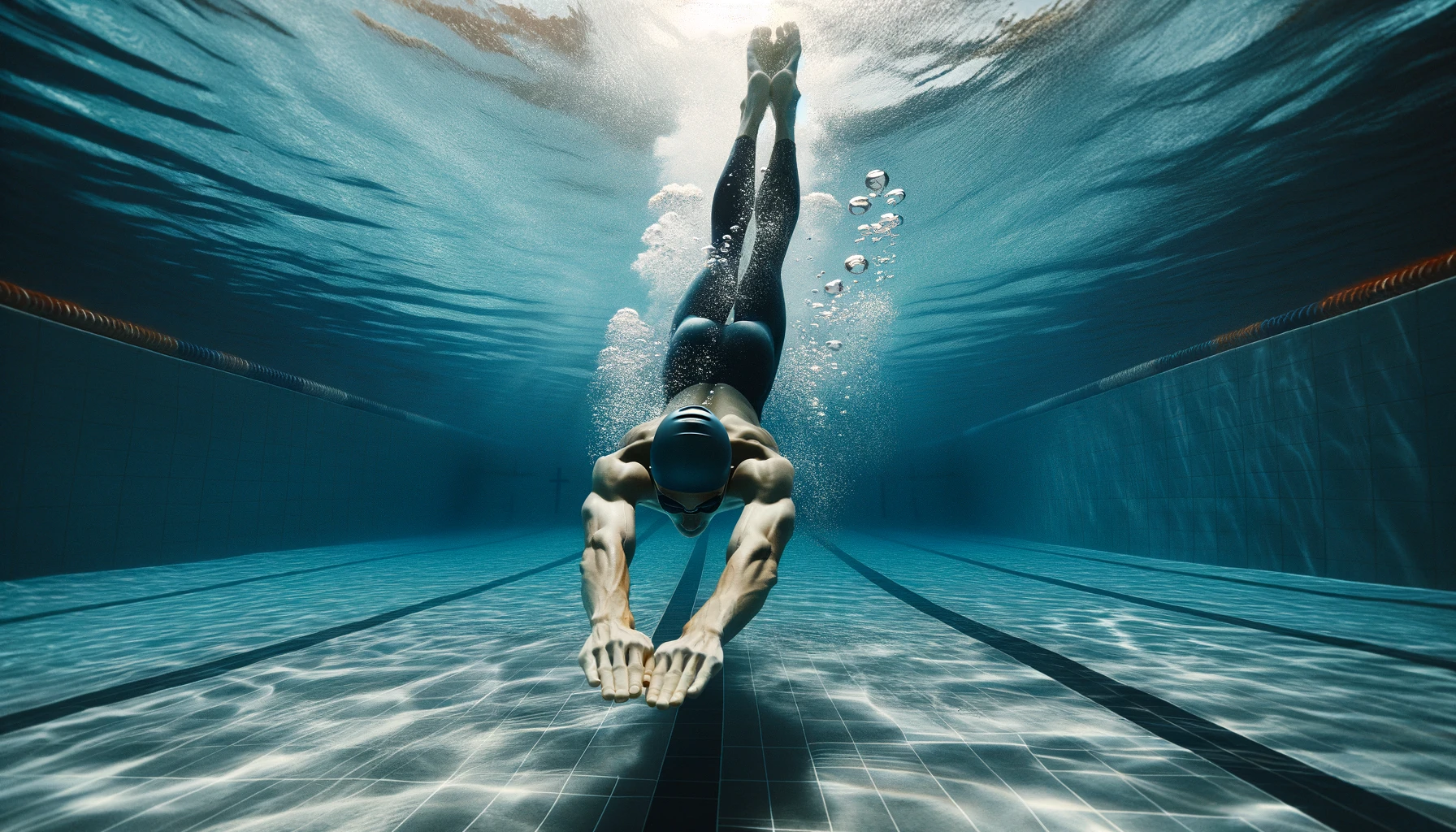
Elite swimmers spend a long time underwater off the wall. They do it inside a controlled programme, supervised, with a coach watching every repetition, at speeds a child cannot generate.
Children copy it by holding their breath and seeing how far they can go.
Repeated or prolonged breath-holding can cause shallow-water blackout. The urge to breathe is triggered by rising carbon dioxide, not by falling oxygen. Hyperventilating first, or simply pushing through the urge to breathe, removes the alarm without adding any oxygen. The swimmer then loses consciousness underwater with no thrashing, no signal and no sound. They sink quietly. Lifeguards miss it because there is nothing to see.
It kills strong, fit, competent swimmers every year, including trained adults, in shallow water, in supervised pools.
So: no breath-holding competitions. No “how far can you go underwater”. No practising underwaters alone. If your child’s coach runs hypoxic sets, ask why, and be unsatisfied with the answer. Underwater speed is trained by shortening the distance and taking full rest, never by extending the breath-hold.
Tell your child the mechanism. Children respond to being told why, once, plainly, far better than to being told no.
Early specialisation
The second thing not to copy. A child who trains as a sprinter at eleven gets fast quickly and then stops improving, usually while their shoulders begin to complain.
Young swimmers should build a broad base across all four strokes. Backstroke and breaststroke develop the rotation and the leg patterns that make a good freestyle later. Butterfly, taught properly and in small doses, builds a rhythm nothing else does. Specialisation can come at sixteen, and it will come faster to the child who has all four.
And if your child simply enjoys racing their friends across the pool, that is enough. Most fast adult swimmers were not fast children. They were children who kept turning up.
Common mistakes
- Letting a child train underwater distance. Covered above. Never.
- Copying the arm recovery. It becomes shoulder impingement on a young swimmer.
- Adding gym work before growth is finished, unsupervised. Ask a qualified strength coach or do not do it.
- Sprinting every session. Sprint quality collapses without rest.
- Ignoring shoulder pain. Pain is information. See a physiotherapist. Never push through.
- Dropping the other three strokes at twelve. The most common and most costly error in age-group swimming.
Frequently asked questions
What events does Caeleb Dressel swim?
Primarily the 50m and 100m freestyle and the 100m butterfly, plus relay legs. He is a sprinter.
Can my child learn anything from watching him?
Yes — the start, the streamline off the wall, and how little his stroke falls apart at the end of a race. Those three transfer.
Is dolphin kick safe for children to practise?
The kick itself, yes, in shallow water, breathing normally, supervised. The underwater version is not a children’s drill.
Should my child specialise in one stroke?
Not before their mid-teens. A broad base across all four strokes produces better adult swimmers and fewer injured ones.
My child’s coach sets hypoxic sets. Is that normal?
It happens, and it should not. Raise it. There is no benefit that justifies the risk of shallow-water blackout.
How do I find a good coach?
Watch a lesson before you pay. Look at whether the coach is in the water and whether every child is moving. swimmingclasses.sg covers group formats, privateswimming.sg covers one-to-one, and swimmingcoach.sg covers credentials. Sport Singapore publishes coaching and water-safety guidance.
Let your child watch the races. Then teach them that the swimmer holding their breath the longest at the local pool is not training — they are taking a risk nobody in that video is taking.


Leave a Reply