

How to improve swimming speed, in one sentence: reduce drag before you add power, because water resists you roughly with the square of your speed — so every bit of streamlining you gain pays you back more than every bit of fitness you build.
This is the part most swimmers get backwards. They swim more lengths, harder, and get marginally faster. Meanwhile the swimmer in the next lane, who trains less, glides past with an easy stroke. The difference is almost never fitness. It is how much water each of them is dragging along.
Below is the order we actually work through with swimmers who want to get faster, from the change that yields most to the one that yields least.
1. Cut Drag First
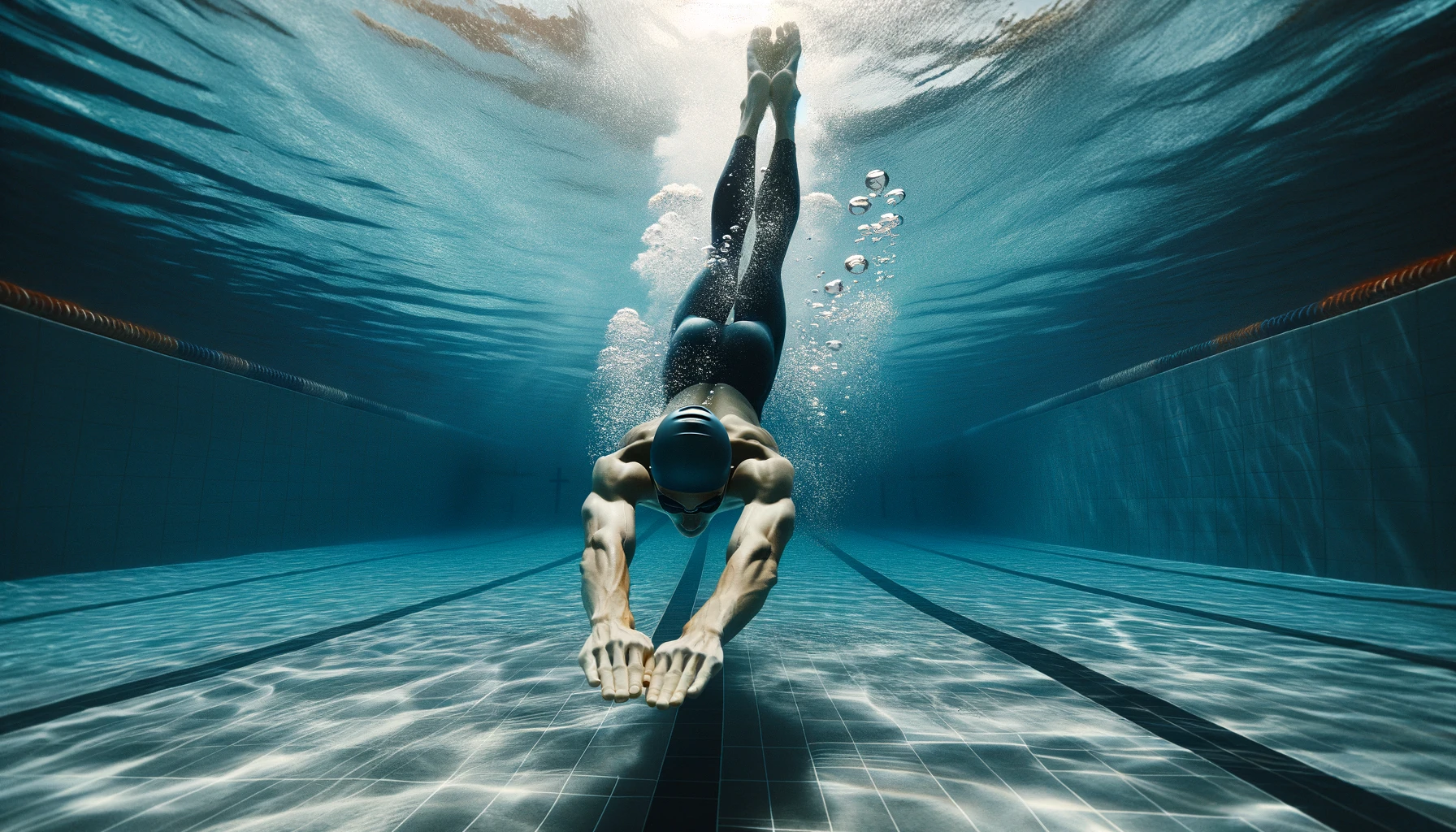
Drag is the tax you pay on every stroke. Because resistance rises steeply with speed, the faster you go the more a sloppy body position costs you. This is why streamlining is the highest-leverage change available to almost every swimmer.
- Get your head down. Eyes on the pool floor. A head lifted to look forward drops the hips and turns your body into a plough.
- Lengthen your body line. Reach long on every stroke. A longer vessel moves through water more efficiently than a short one — the same reason ships are shaped as they are.
- Kick narrow. Feet inside the silhouette of your body. A wide, knee-driven kick is a brake with good intentions.
- Rotate, don’t wobble. Rotation from the hips is propulsive. Snaking side to side is not.
2. Fix the Catch Before You Build the Engine
Strength only helps if you have something to push against. In freestyle, that means the high-elbow catch: elbow near the surface, forearm angled down, hand and forearm together forming one flat paddle facing backward.
Swimmers with a dropped elbow slip through the water. Their hand travels a long way and the water barely notices. Fix the catch and speed appears without any change in fitness at all. The fist drill — swim a length with closed fists, then open your hands — makes the sensation obvious in about thirty seconds. Our full guide to freestyle technique breaks the catch down further.
3. Measure Efficiency, Not Just Effort
Speed is distance per stroke multiplied by stroke rate. Recreational swimmers reflexively raise the second number. Coaches work on the first.
Count your strokes across a 25m length and time it. Add the two numbers together — coaches call this a SWOLF score. Lower is better. Track it weekly. It is the single most honest number in swimming, because it catches the swimmer who is thrashing to make up for poor technique.
| What you’re chasing | What actually moves the needle | What wastes your time |
|---|---|---|
| Lower 100m time | Reducing drag, improving the catch | Swimming more slow laps |
| Faster turns | Streamline off the wall, tight tuck | Pushing off harder in a poor position |
| More power | Core stability, lat and hip strength | Isolated arm curls |
| Better endurance | Structured intervals with rest | Long, unbroken, unfocused swims |
| Efficiency | Falling stroke count at constant speed | Feeling tired as proof of progress |
4. Kick From the Hip, and Sort Out Your Ankles
The freestyle kick contributes less propulsion than most swimmers imagine — its real job is to hold your legs high and stabilise rotation. But a bad kick actively slows you down.
Kick from the hip with a mostly straight leg. Bend at the knee and you are cycling, not kicking. And pay attention to ankle flexibility: stiff ankles present the sole of the foot to the water like a flap, while flexible, pointed ankles slice. Runners and cyclists, in particular, tend to have tight ankles and are often surprised how much a few weeks of ankle mobility work does for their kick.
5. Stop Losing Time at the Walls
In a 25m pool, a significant portion of every race happens at the turn. Swimmers who train exclusively in the middle of the lane leave free time on the wall.
- Approach at full speed. Do not glide into the turn.
- Tuck tight. A small ball rotates faster than a long one.
- Push off on your side, not flat on your back or front.
- Hold a rigid streamline — arms locked overhead, one hand over the other, head tucked between the biceps.
- Start kicking before you surface, and take your first stroke before you slow to swimming pace.
Never practise extended underwater work alone or to the point of discomfort. Hypoxic breath-holding drills carry real risk and should only be done under supervision.
6. Train With Structure, Not Just Volume
Grinding out the same steady 1,500m three times a week teaches your body to be efficient at exactly one pace: that one.
Interval training — shorter efforts with defined rest — lets you swim fast while still holding good technique. That combination is what actually transfers to a faster race. A simple starting structure:
- Warm-up: 200–400m easy, mixing strokes.
- Drills: 4 × 50m focusing on one thing only — catch, or rotation, or breathing.
- Main set: 8 × 50m at hard-but-controlled effort, 20 seconds rest. Stop the set the moment your technique falls apart.
- Cool-down: 200m easy.
That last instruction matters more than the numbers. Swimming fast with bad technique rehearses bad technique. Quality ends the set, not the clock.
7. Build Strength Where It Transfers
Dryland work helps when it targets what swimming actually uses: a stable core to transmit force between hips and shoulders, strong lats and hip flexors, and mobile shoulders and ankles.
Planks, pull-ups, hip bridges and band work for the shoulders give more return than machine isolation exercises. In-water resistance — paddles, drag suits, tethered swimming — also works, but use paddles sparingly. Oversized paddles on a swimmer with a dropped elbow simply load a broken stroke and are a common route to shoulder injury.
8. Recover Properly
Adaptation happens between sessions, not during them. Swimmers who train hard every day plateau, then get injured, then get slower. Build in genuine easy days. Sleep is the most underrated performance intervention available, and it is free.
Eat enough to fuel the work. Hydrate — you sweat in the pool, you simply cannot feel it. If you want a nutrition plan tailored to serious training volume, speak to a qualified sports dietitian rather than following a generic template.
Common Mistakes That Cap Your Speed
- Adding effort to a stroke that leaks. Fix the leak first.
- Holding your breath. Exhale continuously underwater. Breath-holding builds carbon dioxide, panic and tension.
- Judging sessions by exhaustion. Feeling wrecked is not evidence of improvement.
- Never being watched. Stroke faults are invisible from inside the stroke and obvious from the deck.
- Changing five things at once. Work on one cue per session. The nervous system can only rebuild one habit at a time.
Frequently Asked Questions
What is the fastest way to improve swimming speed?
Reduce drag. Get your head down, lengthen your body line and narrow your kick. Because water resistance rises sharply with speed, streamlining returns more than any equivalent gain in fitness — and it works immediately.
Does swimming more lengths make you faster?
Only up to a point. Volume without structure trains you to be efficient at one comfortable pace. Intervals — short, fast efforts with rest — let you practise speed while your technique is still intact, which is what actually transfers.
How do I know if my technique is improving?
Count strokes per length and time the length. If your stroke count falls while your time stays the same or drops, you are genuinely more efficient. If you are simply swimming harder, the count rises.
Should I use hand paddles to swim faster?
Sparingly, and only once your catch is sound. Paddles amplify whatever your stroke already does. Used on a dropped elbow, they load the shoulder joint badly and are a common cause of swimmer’s shoulder.
How important is the kick for speed?
Less than most swimmers think for distance freestyle, where the kick mainly stabilises the body and holds the legs high. It matters far more in sprinting. Either way, a wide, knee-driven kick creates drag and costs you speed regardless of distance.
How long before I see real improvement?
Drag fixes can produce a noticeable change within a single session. Rebuilding the catch takes weeks. Fitness adaptations take months. Expect the ordering to feel counterintuitive: the easiest gains come first, and the plateau arrives once technique becomes the limiter.
Where to Go From Here
Improving swimming speed is largely a matter of removing things — drag, wasted movement, wasted breath — rather than adding them. Most swimmers already possess the fitness to swim considerably faster than they do. What they lack is someone standing on the deck telling them their elbow drops on the left side.
If you are serious about getting faster, get watched. Film a length on a phone from the side and from behind. Or work with a coach — one-to-one coaching and private swimming lessons exist precisely for this, and structured swimming lessons in Singapore are available at public pools and at your own condominium. Beginners should build the foundations first: floating and body position come before speed, always.
National programmes run under Sport Singapore and public pools operated by ActiveSG offer accessible lane time across the island — there is rarely a good reason not to get in the water.


[…] can — see learning in a condominium pool. Once you can swim lengths, the real speed levers are in stroke count and tempo. To find a pool nearby, use swimming near […]