

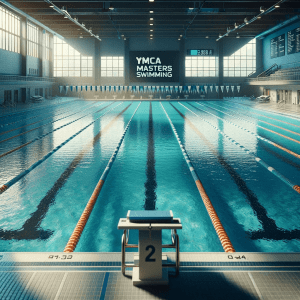
YMCA Masters Swimming is coached squad training for adults, organised in lanes by speed, with no obligation to race. It sits at the far end of a pathway that begins with a four-year-old blowing bubbles in a teaching pool. Most people never travel the whole route, and they do not need to. What matters is knowing which stage you or your child are actually at, because the commonest mistake in swimming is being placed a stage too far along — a child put into a squad before they can swim properly, or an adult sent to a group class when what they need is a private lesson and some quiet.
This article maps the pathway, and says honestly what has to be true before each step.
Stage One: Learn to Swim
The goal here is not a stroke. It is a person who, if they fall in, can turn onto their back, breathe, and get to the side.
Water confidence first. Face in the water, bubbles, eyes open. Then back float, then front float with recovery to standing, then gliding. Strokes come last, and a class teaching freestyle arms to a child who cannot float has skipped the only part that would save them.
Water safety is taught from the first lesson: how to get out, how to rest on your back, why you never swim alone.
Stage Two: Stroke Development
Once a swimmer can cover ten or fifteen metres unaided, the work becomes technical. Body position. Breathing without lifting the head. A kick from the hip rather than the knee. A second stroke, usually backstroke, because it teaches balance and lets a nervous swimmer breathe freely.
This stage takes longer than parents expect and it is the one most often rushed.
Stage Three: Squad or Not
| Stage | Ready when | Typical setting |
|---|---|---|
| Learn to swim | From water confidence onward | Teaching pool, 3-4 per coach |
| Stroke development | Can swim 10-15m unaided | Small group or private lessons |
| Junior squad | Swims 200m; two strokes; enjoys it | Club, several sessions a week |
| Competitive club | Wants to race; parents willing | Serious time commitment |
| Adult masters | Swims 200-400m continuously | Coached adult squad, lanes by speed |
| Adult fitness swimming | Any level | Public lane hours; no squad needed |
A child does not need a squad to be a good swimmer, and a great many children are pushed into one because they were the strongest in their lesson group. Squad training is early mornings, high volume, and a family commitment. It suits children who want it, and damages children who do not.
Stage Four: Masters, Which Is Not What It Sounds Like

“Masters” means adult, not expert. A masters squad contains triathletes, returners, people rehabilitating a knee, a former county swimmer, and somebody who learned to swim at forty-five. Lanes are sorted by speed and the slow lane is fuller than the fast one.
You need to swim two to four hundred metres continuously, freestyle mostly, and read a pace clock. You do not need tumble turns, butterfly, or any interest whatsoever in racing. Most masters swimmers never enter a meet.
What you get is structure, a coach who watches you, and company. Adults who have swum alone for a decade are frequently working twice as hard as necessary, and one competent pair of eyes changes that.
Common Mistakes
- Pushing a child into squad because they are the best in their class. Ask the child.
- Teaching strokes before floating. The most consequential error in the whole pathway.
- Assuming “masters” means advanced. It means adult.
- An adult joining a group class when they are frightened. Private lessons first, always.
- Choosing too fast a lane. You will be miserable within a fortnight.
- Aids that never come off. A class with no incentive to finish.
- Waiting until you are “fit enough” for a squad. Squads are where you get fit.
Safety at Every Stage
A child who cannot swim competently needs an adult within arm’s reach, whatever they are wearing. Armbands, rings and inflatables are toys, not safety devices. Drowning is silent — no shouting, no splashing.
Never allow breath-holding games, underwater distance contests, or hypoxic sets, at any age, in any squad. Repeated or prolonged breath-holding, particularly after hyperventilating, causes shallow-water blackout: a silent, warningless loss of consciousness that has drowned strong swimmers in supervised pools. Some old-school squads still prescribe hypoxic sets. Decline them, and any coach who insists.
Never throw a frightened child into deep water. Coaches meet the results twenty years later, in adult beginners.
Shoulder pain in a swimmer is an overuse injury: reduce volume, remove paddles, see a physiotherapist. Knee pain in breaststroke means stop breaststroke and get it assessed. Neither improves by being trained through.
Swim where a lifeguard is on duty, and never alone.
Where to Start
Wherever you actually are, not where you would like to be. Nervous adults and frightened children progress fastest in one-to-one private lessons, then move into small-group swimming classes. Practice between lessons roughly doubles progress — see learning in a condominium pool. Children with additional needs deserve a coach trained for it, through special needs swimming.
If you are building toward a squad, our beginner swimming routine takes you to four hundred metres continuous, and what a masters squad session involves covers lane etiquette. To find a pool, use swimming near me.
Singapore club structures and competition pathways are published by Sport Singapore; public programmes by ActiveSG.
Frequently Asked Questions
Does masters swimming mean I have to compete?
No. Most masters swimmers never enter a meet. Racing exists, in age groups, and is entirely optional.
How fast do I need to be to join a masters squad?
Not fast. You need to swim two to four hundred metres continuously and share a lane politely. Everything else is learnable.
Should my child join a swim squad?
Only if they want to. Squad training is early, frequent, and a family commitment. Being the strongest in a lesson group is not a reason.
At what age should a child start lessons?
Water familiarisation can start very young; formal stroke work waits for coordination. Confidence matters more than age.
Can adults start swimming from nothing?
Yes, at any age. Adults learn faster than children once fear is handled. They simply arrive with more of it.
Do I need tumble turns for masters?
No. Touch turns are entirely acceptable, and plenty of long-standing masters swimmers never learn to tumble.


Leave a Reply